I have been interested in the immigrant history of New York City for as long as I can remember. My own family history is tied to it (more on that in a future post). But it took time to find the story I wanted to tell.
Finding the inspiration
BBC History Extra, one of my favorite magazines, often provides inspiration in its pages. The November 2020 issue provided such a spark. In an article about the first female detectives in American police departments, a sidebar on Isabella Goodwin, the New York Police Department’s (NYPD) first female detective, caught my eye.
Isabella inspired my 1910 New York City Police Department female detective story about Rose, a widow who gets a job as a typist in the new NYPD headquarters at 240 Centre Street (now luxury condos). She finds herself drawn into a murder case, with the intrepid Isabella Goodwin as her mentor.
Isabella Goodwin

Isabella was born in 1865, the daughter of James Loghry of New York and Anne Jane Monteith from Ireland, proprietors of a hotel and restaurant in Lower Manhattan. At 19, she married NYPD roundsman (the word used then for a patrolman) John Goodwin. They had three sons and one daughter who grew into adulthood, and two sons who died young.
After seven years on the police force, John was accused of abandoning his post. The NYPD was rife with corruption at the time, so it’s hard to know the truth, but he argued that the charge was retaliation for his complaining about higher-ups on the force escorting prostitutes into the station house “for their own enjoyment.”
John was tried on three counts of intoxication, which seems to have had some truth to it. From that point until his death in 1896, he was never sober. He got his badge back at one point, but when he kept showing up at the station house drunk, he was committed to Bellevue Hospital. He died during an apocalyptic heatwave in the city. Some of the vivid contemporary descriptions of that summer make it into my story.
For Isabella, John’s death was a turning point. It was common for the NYPD to hire widows of fallen officers—apparently even disgraced ones. She passed a civil service exam and became a matron at the 8th Precinct on MacDougal Street, and later at the Mercer Street station in Greenwich Village.

What is a police matron?
Matrons were women employees of the Police Department who were in charge of female prisoners. The first jail matrons were appointed in 1845 to the Manhattan House of Detention (better known as The Tombs) and to Blackwell’s Island Asylum, the country’s first municipal mental hospital. But in 1891, after the assault of a young female prisoner, Police Commissioner and future U.S. President Theodore Roosevelt expanded matrons’ duties to deal with female crime victims and cases involving children.
And it was as a matron that Isabella made her mark. Diminutive (she’s stood just above five feet tall), she was described as having a “kind, motherly face” with dark hair “not yet streaked with grey,” grey eyes that were “full of expression and sympathy,” and “a broad forehead [denoting] intelligence.” She dressed with precision and had tiny feet. These are the kinds of details writers relish!
Isabella at work
Her sleuthing skills were clear from the start. She specialized in exposing fortune tellers, astrologers, magicians, “quack healers,” and gamblers. She obtained evidence against more than 500 swindlers, often going undercover disguised as a degenerate gambler or a naïve society matron.

She worked hard, pulling 13-hour shifts while her mother watched her children. Being the closest station to the Central police station, Mercer Street was the way station for booking the toughest female criminals, including those accused of murder and theft, gang leaders (who trafficked in furs and gems), as well as some categories of criminals we don’t see anymore: shirtwaist factory strikers and “counterfeit nuns with healthy bank accounts.”
Isabella’s superpower was her sympathy. She talked to the women as if they were human beings, not just criminals. Her sympathetic ear was said to be the tap on the spigot that got women to talk. She was also fearless: she could lie to thugs who towered over her and never flinch, never lose the evenness of her voice.
In 1912, her central role in breaking up a major heist in the Financial District by Eddie “The Boob” Kinsman (she befriended Eddie’s sweetheart Swede Annie Hull) led to her become the NYPD’s first female detective (first-grade), earning $1,000 per year—less than half of what a first-grade male detective earned then. She was granted the title of lieutenant and the right to wear a detective’s gold shield. By that time, one son was also a police officer and her daughter was a department store detective.

Isabella’s life
But it was the details of her life that also jumped out at me. She had longed to be an opera singer. Throughout her life, she remained devoted to opera, a point of commonality with my main character, Rose. Her kindness and sympathy toward the women she worked with led me to make her Rose’s mentor as she starts her job at the NYPD. Isabella pulled other women up behind her to success. In 1921, she led the NYPD’s new Women’s Bureau of 26 female officers who were charged with overseeing cases involving prostitutes, runaways, truants, and victims of domestic violence.
Isabella’s love of opera and how her later years played out led me to think she was also something of a romantic, despite all the pain she had seen in her own life and work. In 1920, Isabella lived in a rooming house on Hoyt Street in Brooklyn. There she met Oscar Seaholm, a baritone soloist who sang in churches around the city. He was 23, she was 55 when they married in 1921. She retired from the police in 1924 and died, still happily married to Oscar, in 1943.
When I read that article in BBC History Extra, I knew Isabella needed to be part of my story.

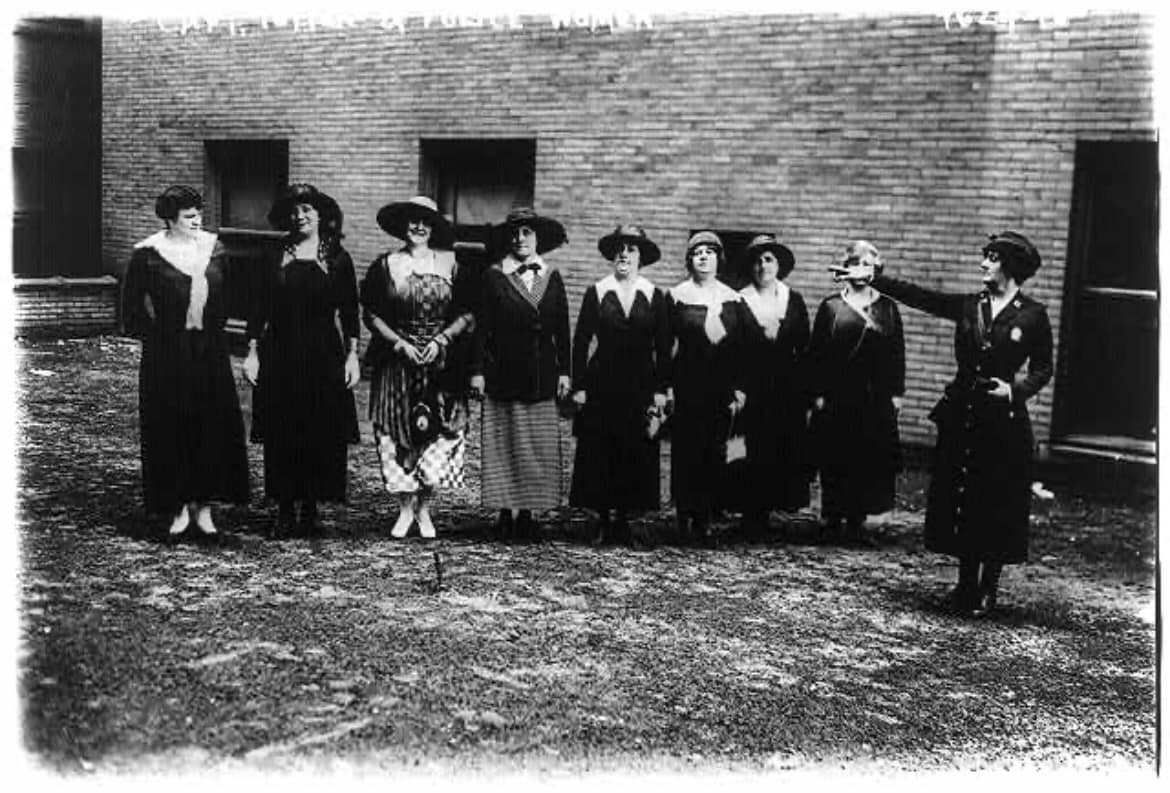
Source for featured image: Library of Congress (police women, New York City, June 25, 1918)
Additional resources
The Fearless Mrs. Goodwin: How New York’s First Female Police Detective Cracked the Crime of the Century by Elizabeth Mitchell
“Sherlock Holmes in skirts”: the world’s first policewomen in BBC History Extra, November 2020
Overlooked No More: Isabella Goodwin, New York City’s First Female Police Detective in The New York Times, March 13, 2019
Historical and Current Research: Women in the NYPD, John Jay College of Criminal Justice, City University of New York
For a historical fiction read, Sara Howard in Caleb Carr’s 1994 novel The Alienist was based on Isabella Goodwin

Leave a Reply to The Mysterious Death of Elsie Helair, New York City, 1917 – Kate RobertsonCancel reply