
The protagonist of my upcoming Tudor suspense series, Anne Winston, is my thirteenth great-grandmother. Finding her in my family tree inspired me to create a story about her as a gentlewoman spy in the court of Queen Elizabeth I.
Anne’s family and upbringing
Born Anne de Burgh (attention, fellow Austenites!) around 1525, she was the twelfth or thirteenth child of Thomas Burgh, Baron de Burgh of Gainsborough in Lincolnshire and Agnes Tyrwhitt. Sir Thomas was a King’s Spear, a bodyguard to Henry VIII. Later, he became Chamberlain to Anne Boleyn during her queenship. He was one of twenty-six peers of the realm summoned to her execution in 1536.
As a father, he reportedly was cruel, ruling with an iron hand, and prone to violent rages. All backstory for how my Anne moves through the world and Elizabeth I’s court.
The direct connection to Henry VIII and the seeds of a story
Sir Thomas’ eldest son, Edward, was the first husband of Katherine Parr, later Henry VIII’s sixth and final wife. Edward and Katherine were married for about four years before his death (in 1533 or 1534), with no children. They lived for a time with his parents, and Katherine wrote to her mother about the tyranny of her father-in-law.
When Sir Thomas’ second eldest son, also named Thomas, died in 1540, the elder Thomas accused his son’s widow, Elizabeth, of adultery and threw her and her children out of the house. He even petitioned Henry VIII to have his grandchildren declared illegitimate, a request subsequently granted by an Act of Parliament. There is no indication of what prompted this, but given his tyrannical and ruthless nature, one can make assumptions. This is the seed that grew into my story.
Anne married at fifteen. The historical archives are unclear as to whom she married. I have found three different potential husbands for her. Such old records can be murky, especially given the relative lack of diversity in names at the time.

Who was Anne Winston?
If, as I believe, she married Thomas Winston of Standish, Gloucestershire, she would have had two sons: Anthony and Henry. I’m most likely descended from Anthony. (As an aside, Winston Churchill also purportedly descended from Henry, making us very distant cousins!)
For the purposes of my story, Anne is a 40-year-old widow with two teenage sons. While little is documented about her life, I found one reference that said she died at court, so I made her a Lady of the Privy Chamber. She likely had several surviving siblings, but for ease of reading, I have incorporated only two: William, the third eldest (but eldest surviving) brother and Dorothy, an older sister. The historical Dorothy had been a nun, despite their father’s committed adherence to the new, reformed (i.e., Protestant) religion, and I wrote her as living in a community with other former nuns, a complicating factor in a world rupturing along the Catholic-Protestant divide.

Bringing Anne to life
My story begins with Anne at court in 1565. She learns from her disinherited niece that her nephew has been arrested for sedition, i.e., inciting rebellion against the state, and “unnatural acts,” during this period a euphemism for homosexuality. At this time, sedition was a charge often levied at Catholics for not recognizing the authority of the (newly-Protestant) monarchs.
Anne seeks to exonerate her nephew from the sedition charge, while keeping the accusation of “unnatural acts” secret. Though both crimes were punishable by death, the violation of the Buggery Act of 1533 was often an arbitrary add-on to other charges to worsen the case—and it was infinitely harder to disprove than sedition. Also at court are troublemakers, both religious and personal, as well as Anne’s complicated childhood love, Nicholas, Earl of Madden.
Anne’s nephew is a friendless, hapless scapegoat caught up in a web of intrigue far beyond his own ability to cope. To save him, Anne must find her inner strength, while using her own unique skills, including systems of written and embroidered encryption she had developed to avoid her father’s wrath, to help ferret out the true evil lurking in Elizabeth I’s court – all before the executioner’s axe falls on her innocent nephew’s neck.
It is inspiring to find women like Anne in my family tree. I hope that women like her, invisible and forgotten in the darkness of history, used the power, skills, and smarts they had to protect the vulnerable. Within a morsel of family history, I wanted to bring to life what could have been.
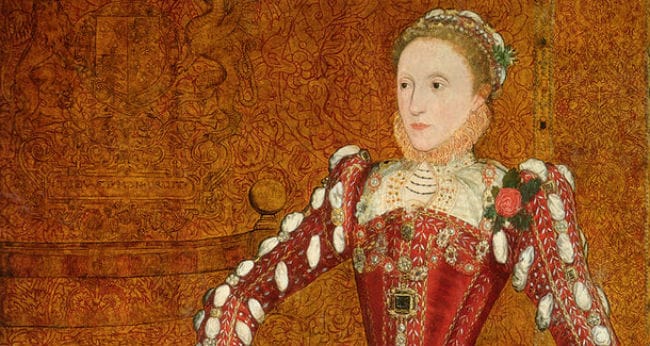
Featured image: Hampden portrait of Elizabeth I. Painted in the mid-1560s, it was the first full-length portrait of the queen.


Leave a Reply